



SenseCAP MeshTracker X1
Card-Sized Meshtastic Tracker with Dual-Band GPS
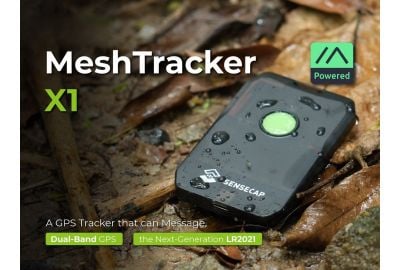
Dual-band GNSS, a built-in barometer, IP66 protection and a rechargeable battery, all in a device measuring just 90 × 57 × 8mm. The SenseCAP MeshTracker X1 combines location sharing and off-grid messaging in a compact, everyday-carry design.
Explore the MeshTracker X1Off-Grid Communication, Made Portable
Whether you are hillwalking, cycling, attending a large outdoor event or experimenting with mesh radio networks, carrying additional equipment is not always convenient. The SenseCAP MeshTracker X1 from Seeed Studio is designed to address that problem with a compact tracker that weighs just 45g.
Measuring 90 × 57 × 8mm, the X1 can be carried in a pocket, attached to a bag or worn on a lanyard. Its internal antennas, rechargeable battery and weather-resistant enclosure make it suitable for portable use without requiring a separate radio, external antenna or battery pack.
Running Meshtastic firmware, the X1 communicates directly with other compatible LoRa devices over radio. It can transmit position information, exchange text messages and participate in a wider mesh network without requiring a mobile phone signal, SIM card or subscription.
How Does Meshtastic Work?
Meshtastic is an open-source, decentralised communication system that uses LoRa radio technology to exchange messages and location information over relatively long distances at low data rates.
Unlike conventional mobile messaging, communication does not depend on a cellular network or an internet connection. Each Meshtastic device operates as a radio node, transmitting and receiving packets over the air.
Nodes discover one another automatically. There is no requirement to manually add or pair with every other node in the network. When devices are within radio range and use compatible LoRa settings, they can receive one another's transmissions. The appropriate channel configuration and encryption keys are also required to read encrypted messages.
Depending on the device role and configuration, nodes can also rebroadcast packets received from other devices. This allows messages to travel beyond a single direct radio link, provided suitable intermediate nodes are available and the permitted hop limit has not been reached.
Bluetooth connects the MeshTracker X1 to your smartphone so you can configure the device and use the Meshtastic app. LoRa handles communication between Meshtastic nodes. Other compatible nodes are discovered over radio rather than paired individually through Bluetooth.
In the UK, Meshtastic devices normally use the EU_868 regional setting. This operates within the applicable licence-exempt short-range device framework, subject to the relevant frequency, power and duty-cycle restrictions. An amateur radio licence is not required for compliant operation.
Designed for Reliable Portable Operation
The MeshTracker X1 combines a modern LoRa transceiver, dual-band satellite positioning and several practical features for outdoor use.
Dual-Band L1 + L5 GNSS
By receiving GNSS signals on both L1 and L5 frequency bands, the X1 can improve positioning performance compared with conventional single-band receivers, particularly where multipath reflections and other signal challenges are present. Actual accuracy remains dependent on satellite visibility and surrounding conditions.
Integrated Barometer
The built-in pressure sensor measures atmospheric pressure and provides temperature readings. Barometric pressure can also be used to estimate altitude, although accurate absolute altitude estimates depend on appropriate reference pressure or calibration.
Semtech LR2021 Transceiver
The X1 uses Semtech's LR2021 radio chipset, supporting frequencies between 863 and 928MHz with a specified maximum transmitter output of 22dBm. Seeed Studio quotes receiver sensitivity down to -141dBm. The chipset also supports FLRC operation, although its maximum FLRC data rate should not be confused with the throughput available through normal Meshtastic messaging.
IP66-Rated Enclosure
The enclosure is rated dust-tight and protected against powerful water jets, making it well suited to outdoor conditions such as rain and dusty environments. IP66 does not indicate suitability for immersion. The specified operating temperature range is -20°C to +60°C.
Vibration, Buzzer & LED
A vibration motor, built-in buzzer and RGB status LED provide feedback without requiring a screen. The single multifunction button allows basic operations such as switching GPS on or off, broadcasting updated node information and temporarily muting the buzzer.
1100mAh Battery & USB-C
An internal 1100mAh rechargeable battery provides portable power, with Seeed Studio advertising up to five days of operation under suitable conditions. Battery life depends on settings, GPS activity, radio transmissions and usage. USB-C provides charging and a connection for firmware maintenance.
What Range Can You Expect?
Seeed Studio reports communication distances of up to 8 kilometres in open line-of-sight testing at 915MHz. This demonstrates what the hardware can achieve under favourable test conditions, but it should not be interpreted as a guaranteed operating distance.
For UK users, the X1 should be configured for the applicable EU_868 radio region. The manufacturer's 915MHz test result is not a verified range measurement for operation under UK EU_868 settings.
As with other low-power radio equipment, practical range is influenced by several factors:
Extending Coverage Through a Mesh
One of the advantages of Meshtastic is that communication need not be limited to two devices within direct radio range. Other suitably configured nodes can rebroadcast packets, potentially allowing messages to reach more distant locations.
For example, a fixed Meshtastic node installed in an elevated position may provide useful coverage between portable trackers that cannot hear each other directly. The SenseCAP Solar Node P1 Pro is one option for permanent or semi-permanent outdoor installations.
Not every Meshtastic node rebroadcasts traffic. Relay behaviour depends on the configured device role and network settings, and packets are subject to hop limits and airtime restrictions. Good node placement and appropriate configuration are therefore more important than simply increasing the number of devices.
Your Smartphone Becomes the Interface
Unlike some larger Meshtastic devices, the MeshTracker X1 does not have a display. Instead, it connects to a compatible smartphone over Bluetooth, allowing you to manage the device through the free Meshtastic app for Android or iOS.
Through the app, you can configure your radio settings, send and receive text messages, inspect discovered nodes and view position information shared by devices on the network.
Once configured, the X1 can operate as a radio node without maintaining a continuous connection to your phone. However, the phone is needed to use the app-based messaging interface, view maps and make configuration changes.
Getting Started with the MeshTracker X1
Simple Button Controls
The X1 uses a single multifunction button for common operations. The following controls apply to the manufacturer's documented Meshtastic configuration.
| Button Action | Function |
|---|---|
| One press | Power on, accompanied by a rising melody |
| Two presses | Broadcast node information and position |
| Three presses | Switch GNSS positioning on or off |
| Four presses | Temporarily mute or unmute the buzzer |
| Hold for 5 seconds | Power off, accompanied by a falling melody |
Meshtastic and MeshCore: What Is the Difference?
Seeed Studio provides documentation for operating the MeshTracker X1 with both Meshtastic and MeshCore firmware. Although both technologies use LoRa radio hardware for off-grid communication, they are separate networking systems with different protocols and operating approaches.
Meshtastic uses a decentralised mesh model in which suitably configured nodes can relay packets. MeshCore uses its own protocol, with device roles including companions and dedicated repeaters.
The two systems are not directly interoperable. A device running Meshtastic firmware cannot automatically exchange messages with a MeshCore network. Choosing between them involves running the appropriate firmware and using compatible devices within the chosen system.
Who Is the MeshTracker X1 For?
Its combination of portability, satellite positioning and LoRa connectivity makes the X1 useful across a variety of activities.
Hillwalking & Hiking
Exchange messages and share positions with other suitably equipped members of a walking group, including locations beyond mobile network coverage where radio links are available.
SOTA & POTA Operations
Provide a lightweight additional communications link for amateur radio activations, with GNSS position sharing and barometric measurements.
Cycling & Running
Carry a compact position-sharing device without the bulk of a conventional handheld radio, suitable for use with other members of a compatible mesh network.
Events & Volunteer Teams
Support short-message communication and location awareness at large outdoor sites where mobile networks may be congested or unreliable.
Emergency Preparedness
Add an independent, short-message radio capability to a wider communications plan without relying on cellular infrastructure. Coverage remains dependent on the available radio network.
LoRa & Mesh Enthusiasts
Explore mesh networking, portable GNSS devices and the effect of antenna placement and terrain without assembling a tracker from separate modules.
SenseCAP MeshTracker X1 Specifications
| Specification | Details |
|---|---|
| Manufacturer | Seeed Studio / SenseCAP |
| Model | MeshTracker X1 |
| Main Controller | Nordic nRF52840 |
| LoRa Transceiver | Semtech LR2021 |
| Hardware Frequency Range | 863 to 928MHz |
| Maximum Hardware TX Power | 22dBm (subject to regional limits) |
| Specified RX Sensitivity | Down to -141dBm |
| GNSS | Dual-band L1 + L5 |
| Bluetooth | Bluetooth 5.0 |
| Antennas | Internal GNSS, LoRa and Bluetooth |
| Barometer Measurement Range | 300 to 1100hPa |
| Temperature Measurement | Via built-in pressure sensor |
| Indication | RGB LED, buzzer and vibration motor |
| Controls | Single multifunction button |
| Battery Capacity | 1100mAh rechargeable |
| Advertised Battery Life | Up to 5 days, depending on use |
| Charging & Data | USB-C |
| Charging Temperature | +5°C to +45°C |
| Protection Rating | IP66 |
| Operating Temperature | -20°C to +60°C |
| Dimensions | 90 × 57 × 8mm |
| Weight | 45g |
| Listed Certifications | CE, FCC, RoHS and TELEC |
A Compact Addition to Your Meshtastic Network
The SenseCAP MeshTracker X1 brings together dual-band GNSS, modern LoRa hardware, environmental sensing and convenient USB-C charging in a lightweight, IP66-rated enclosure. Whether you are building your first Meshtastic network or adding portable devices to an existing installation, it offers a practical way to introduce location sharing and messaging into your setup.
Shop SenseCAP MeshTracker X1 Explore Meshtastic & LoRa