



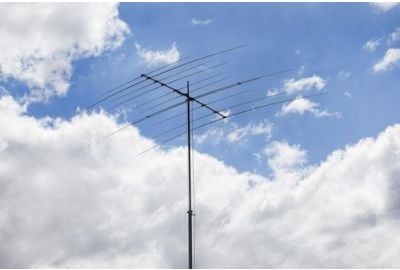
If you've ever wondered why HF bands can be full of DX one minute and completely dead the next, the answer lies in propagation. Every HF contact you make — whether it's a local ragchew on 80m or a rare DX station 6,000 miles away — depends on the state of the atmosphere above your antenna at that exact moment. Understanding how that works doesn't just satisfy curiosity; it can transform your operating results, helping you pick the right band, the right time, and the right expectations before you even key up.
What is HF Propagation?
HF propagation refers to how radio signals in the high-frequency spectrum (roughly 3–30 MHz) travel far beyond line-of-sight by interacting with the Earth's atmosphere — specifically a region called the ionosphere, a layer of electrically charged particles starting around 60 km up and extending several hundred kilometres into space.
Rather than carrying on into space, HF signals are often refracted (bent) back down toward the Earth's surface. This bending — commonly called "skip" — is what allows a relatively modest HF station to be heard hundreds or even thousands of miles away, often well beyond the horizon.
Two terms are worth knowing from the outset:
- Maximum Usable Frequency (MUF) – the highest frequency that will reliably refract back to Earth on a given path at a given time. Try to operate above the MUF and your signal simply punches through the ionosphere into space.
- Lowest Usable Frequency (LUF) – the lowest frequency that won't be completely absorbed before it can be useful. Go below the LUF and your signal is swallowed long before it gets anywhere.
Everything else in this guide is really about understanding how the MUF and LUF shift through the day, the seasons, and the solar cycle — and how to fit your operating around them.
Meet the Ionosphere: D, E and F Layers
The ionosphere isn't a single uniform layer — it's made up of several regions, each behaving differently depending on how strongly the Sun is ionising it at any given moment:
- D-layer (~60–90 km) – The lowest layer, and mostly a nuisance for HF operators. It absorbs rather than refracts signals, and it's strongest when the Sun is highest in the sky. This is the main reason lower bands such as 80m and 60m are hard work during the day — your signal is being soaked up before it can reach the higher layers. The D-layer largely disappears after dark, which is exactly why those bands "open up" at night.
- E-layer (~90–150 km) – A more variable layer that can sometimes refract signals, occasionally enabling shorter "single-hop" contacts. The E-layer is also home to Sporadic-E (more on that below), which can produce surprisingly strong short-skip openings on the upper HF bands and even 6m.
- F-layer (~150–500 km) – The real workhorse for long-distance DX, particularly on 20m and the higher bands. During the day it often splits into two sub-layers, F1 and F2, with the F2 layer being the one that makes round-the-world contacts possible. Its height and ionisation level vary enormously with time of day, season, and where we are in the 11-year solar cycle.
Because these layers are constantly changing with solar activity, time of day, and season, propagation is never static — which is exactly what makes HF such an endlessly interesting (and occasionally frustrating) hobby.
Day vs Night: Why the Bands Change
The single biggest factor in day-to-day propagation is simply whether the Sun is up over the path between you and the station you're trying to work. As a rough guide:
| Band | Daytime behaviour | Night-time behaviour |
|---|---|---|
| 80m / 60m | Heavily absorbed by the D-layer — short range, lots of noise | D-layer disappears — excellent for medium and long-haul DX |
| 40m | Useful for regional/NVIS-style contacts | Opens up for long-distance DX, often the best all-round night band |
| 20m | The classic daytime DX workhorse band | Can remain open well into the evening, especially east–west paths |
| 17m / 15m | Good DX during periods of higher solar activity | Usually closes shortly after sunset |
| 12m / 10m | Best during high solar activity; can be wide open or completely dead | Normally closed, except for occasional Sporadic-E |
If you've ever struggled to work DX on 80m at lunchtime, this table tells you exactly why — the D-layer is simply soaking up your signal before it has a chance to do anything useful.
The "Grey-line" — propagation's best-kept secret
One of the most productive — and most overlooked — windows is the grey-line: the band of twilight that circles the Earth at sunrise and sunset. During this period, the D-layer has weakened or not yet formed, but the F-layer is still well ionised from the previous day. The result is often a short but dramatic enhancement on the lower bands (80m, 40m, and sometimes 30m), making dawn and dusk prime DX-hunting time.
Solar Activity: The Driving Force
While the time of day sets the basic pattern, the Sun sets the overall ceiling on what's possible. Solar activity directly controls how strongly the ionosphere is ionised, and therefore how high in frequency the MUF can climb. A handful of key numbers, broadcast daily, give you a surprisingly good feel for conditions before you even switch the radio on:
| Indicator | What it measures | What to look for |
|---|---|---|
| Sunspot Number (SSN) | Number of visible sunspots — a long-term marker of where we are in the 11-year solar cycle | Higher numbers generally mean a higher MUF and better high-band conditions |
| Solar Flux Index (SFI) | Strength of solar radio emissions at 10.7 cm — a good day-to-day proxy for ionisation levels | Values above ~100 are often a good sign for 15m and 10m openings |
| A-Index | A daily average measure of geomagnetic activity | Lower values (single digits) indicate a calm, stable ionosphere |
| K-Index (Kp) | Short-term (3-hourly) measure of geomagnetic disturbance, on a scale of 0–9 | 0–3 = stable and good for HF DX; 5+ = possible HF degradation, especially on polar paths |
When solar conditions line up — high SFI, low Kp — bands like 10m can suddenly open up worldwide, sometimes even with fairly modest antennas and power levels. The flip side is also true: a big geomagnetic storm (high Kp/A-index) can cause an HF "blackout" on polar paths even while the rest of the band looks normal.
Other Propagation Effects Worth Knowing
- Sporadic-E (Es) – Sudden, dense patches of ionisation in the E-layer can produce intense but short-lived openings on 10m and even 6m, most common in late spring and early summer. These openings can appear with little warning, so it's worth keeping half an eye on the upper bands during Es season.
- Geomagnetic storms and aurora – Strong solar storms can push the Kp index up sharply. While this can occasionally enable unusual VHF "aurora mode" contacts, it generally degrades HF propagation, often introducing flutter or completely closing polar paths for a period.
- The 11-year solar cycle – Beyond the day-to-day picture, the longer-term sunspot cycle sets the baseline for what's achievable on the higher bands. During a solar maximum, 10m and 12m can be reliably open for long stretches; during a solar minimum, those same bands may barely open at all.
Making Propagation Work for You
Understanding propagation isn't just theory — it's a practical operating tool. A few habits can make a noticeable difference to your results:
- Choose the right band for the time of day — don't fight the D-layer on 80m at noon if 20m is wide open.
- Check the current SFI, A-index and Kp before calling CQ, especially if you're chasing DX.
- Take advantage of the grey-line window at your local sunrise and sunset for low-band DX.
- Keep an ear on the higher bands during Sporadic-E season for surprise 10m/6m openings.
- Adjust your expectations based on conditions — a quiet band isn't always a faulty antenna; sometimes it's just the ionosphere.
- Log solar indices alongside your contacts — over time you'll build an intuitive feel for what "good conditions" look like on your own station.
Even a simple station — a basic dipole and 100W — can achieve excellent DX results when paired with good timing and an understanding of what the ionosphere is doing.
Stay One Step Ahead
Keeping an eye on solar conditions in real time gives you a genuine, practical advantage on HF. Instead of guessing why a band is quiet — or missing a brief Sporadic-E or grey-line opening because you weren't looking — you can make informed decisions about when, and where, to point your antenna.
That's where having a dedicated solar activity display in the shack becomes invaluable: an at-a-glance view of the SFI, sunspot number, A and K indices, and current band conditions, updating continuously so you never have to go hunting for the numbers mid-pile-up.
View the ShackComs Solar Activity Monitor
Closing Thoughts
HF propagation can feel like a black art, but at its heart it's governed by a fairly small set of factors: the time of day, the season, and the state of the Sun. Once you start paying attention to the D, E and F layers — and to the daily solar indices that describe them — band conditions stop feeling random and start feeling like something you can plan around. Whether that means working the grey-line for a rare 80m DX contact, catching a Sporadic-E opening on 10m, or simply knowing when not to bother calling CQ on a dead band, a little propagation knowledge goes a long way toward better results on HF.
Disclaimer: This post is intended as a general introduction to HF propagation for newer operators and is not exhaustive. Propagation is highly variable and influenced by many factors beyond those covered here — always use real-time solar data and band condition reports alongside your own on-air experience.
