



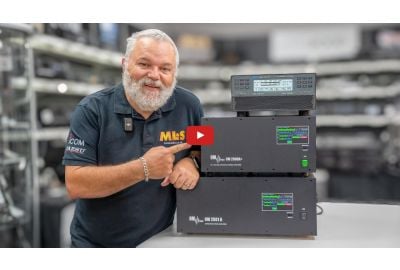
It's one of the most-asked questions in any shack: do I actually need more power? The honest answer, as David M0TPT explains in this video, is that it depends, but for many operators, moving from 100W to 400W or beyond makes a real and noticeable difference that goes well beyond what the S-meter suggests.
David's Own Experience: 50W to 400W
David's own amplifier story is a familiar one to anyone who's made the jump. Running 50 watts, he was getting out but not always getting through. Moving up to 400W changed things in ways he hadn't fully anticipated: not just a signal that was louder, but one that sounded cleaner and fuller on the other end. Reports improved not just in strength but in audio quality and readability. In a busy pile-up, the difference between being heard and being walked over often comes down to that extra headroom.
The maths here are worth understanding. Going from 100W to 400W is a 6dB increase, roughly one S-unit on a calibrated meter. That might not sound dramatic, but in practice the difference between "QRM, please repeat" and a clean first-call copy is often less than one S-unit. The improvement in perceived audio quality, because the amplifier isn't being pushed hard, can be just as significant as the raw power increase.
UK Licence Power Changes
David also touches on the recent changes to UK licence power limits, which are worth being aware of. The maximum power permitted under a Full UK Amateur Radio Licence has increased, giving operators more room to run legally. If you've been holding off on an amplifier because you weren't sure of the rules, it's worth checking the current Ofcom licence conditions, and this video gives a useful summary of where things stand.
OM Power Amplifiers
David looks at two models from OM Power, a Slovak manufacturer with a well-established reputation for building solid, well-engineered amplifiers for serious HF use.
OM Power OM2501A
A compact, fully automatic 2500W amplifier covering 160m through 6m. Auto-band switching, built-in ATU, and a robust design that's become a reference-class choice for serious HF operators.
View at ML&SOM Power OM-2000A+
A high-power automatic amplifier delivering 2000W output, with full band coverage, auto-tune and a design built for extended periods of operation. A popular choice for DXers and contesters.
View at ML&SACOM and SPE Amplifiers
David also covers two more brands that regularly come up in amplifier discussions at this level. ACOM from Bulgaria and SPE from Italy both produce highly regarded amplifiers popular with UK operators.
ACOM 1500
A popular choice in the ACOM range, delivering 1500W output with full HF and 6m coverage. The ACOM 1500 incorporates a manual antenna tuner, capable of handling a mismatch of 3:1.
View at ML&SSPE Expert 1.5K-FA Taurus
A fully solid-state 1500W amplifier from Italian manufacturer SPE, with an integrated auto-tuner, a compact chassis and a modern feature set aimed at operators who want serious power without valves.
View at ML&SValve vs Solid-State: The Big Debate
One of the most interesting sections of the video is David's take on the valve versus solid-state question, a debate that still generates strong opinions on both sides. Here's a summary of the key points:
| Valve (Tube) | Solid-State (Transistor) | |
|---|---|---|
| Warm-up time | Typically 1–3 minutes to reach operating temperature | Instant, ready to transmit immediately |
| Ruggedness (SWR tolerance) | Generally more forgiving of mismatched loads | Can be more sensitive to high SWR, so protection circuits are essential |
| Efficiency | Lower, generates more heat for the same output | Higher, typically more power from the same mains draw |
| Maintenance | Valves eventually need replacing, a known ongoing cost | No consumable components under normal use |
| Size and weight | Tends to be larger and heavier | Increasingly compact, some very lightweight units available |
| "Feel" and heritage | Preferred by many experienced operators; a strong enthusiast following | Modern, practical, increasingly the choice for new builds |
David's conclusion is a pragmatic one: both technologies work well in modern amplifiers, and the choice often comes down to personal preference, operating style and budget as much as any objective technical difference. Valve amplifiers retain a devoted following, particularly among operators who have grown up with them or who appreciate the different operating characteristics. Solid-state amplifiers are increasingly dominant in new designs thanks to their efficiency, instant-on operation and falling component costs.
The ACOM 1000 On-Air Test
Perhaps the most compelling part of the video is the live on-air test using an ACOM 1000, a widely respected valve-based 1000W amplifier that has been a popular choice in UK shacks for many years. Rather than relying on theoretical comparisons or bench measurements, David runs a real QSO with and without the amplifier, and the results speak for themselves. Watch the video from the 12:08 mark to see (and hear) exactly what the difference sounds like in practice.
So, Do You Really Need One?
David's final thoughts are worth watching in full (from 15:41), but the honest summary is this: if you're already running a decent antenna and a well-set-up 100W station, an amplifier is unlikely to fix poor operating habits or a compromised antenna system. But if your station is in reasonable shape and you're regularly finding yourself on the losing end of pile-ups, struggling to hold a frequency in noisy conditions, or simply not getting the reports your antenna should be delivering, then yes, more power genuinely helps, and the amplifiers in this video represent some of the best choices for UK operators at a range of budgets and power levels.
View Linear Amplifiers at ML&S
Amplifiers Featured in This Video
- OM Power OM2501A 2500W auto-tune, 160m to 6m
- OM Power OM-2000A+ 2000W auto-tune, full HF
- ACOM 1500 1500W, HF and 6m, manual tuning
- SPE Expert 1.5K-FA Taurus 1500W solid-state with auto-tuner
All product links and prices were correct at the time of writing; please check the ML&S website for current availability and pricing.
