



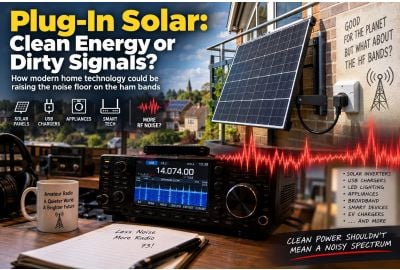
For many radio amateurs, one of the biggest challenges of operating from home is no longer the size of the garden, getting an antenna high enough, or persuading the other half that another piece of aluminium really is necessary.
It is noise.
The modern home is absolutely packed with electronics. USB chargers, LED lighting, televisions, computers, broadband equipment, smart appliances, solar installations, battery chargers, heat pumps, and countless switched-mode power supplies operate around us every day.
Individually, many cause little or no noticeable problem. But put dozens of electronic devices into one house and hundreds into a typical residential street, and the result can be a considerably higher RF noise floor.
The RSGB points out that computers, switched-mode power supplies, mains-powered LED lamps, dimmers and electric motors are all potential sources of interference. Symptoms can range from individual carriers and buzzing noises to sweeping signals or a general increase in background noise across an entire band.
And there is another technology about to become increasingly relevant to UK radio amateurs: plug-in solar.
Plug-In Solar Is Coming to the UK
During 2026, the UK Government moved forward with proposals to permit what it calls plug-in solar or plug-in microgenerators.
These are relatively small solar PV systems designed to connect directly to a normal UK mains socket rather than requiring the conventional permanently wired solar installation many of us are familiar with.
The Government intends to change the regulations so compliant systems can be sold and connected in the UK, subject to an Interim Product Specification. As of September 2026, those regulatory changes have not yet come into force, so this is very much an emerging technology rather than something amateurs should assume is already generally permitted.
From an energy point of view, the attraction is obvious. A small number of panels could be mounted on a suitable balcony, wall, garage or other location and connected relatively simply.
But from an amateur-radio point of view, there is another question: what is that equipment going to do to our HF noise floor?
The Solar Panel Isn't Necessarily the Problem
A solar panel produces DC electricity and usually isn't the part we should worry about most.
The connected electronics are potentially much more interesting.
Solar installations require electronics to convert and control the power being generated. Depending on the system, this can include an inverter, MPPT circuitry, DC-DC converters and, in larger systems, individual panel optimisers.
These circuits operate by rapidly switching electrical currents on and off. Done properly, with good design, filtering, shielding and installation practices, this need not cause serious interference. Done badly, however, switching electronics can generate harmonics and broadband RF noise.
The RSGB has been gathering reports from amateurs about interference associated with solar PV installations for some time and specifically asks about the make and model of inverter and whether panel optimisers are installed.
Radiated Noise and Conducted Noise
There are two important ways unwanted RF energy can reach our radio.
Radiated interference occurs when a poorly suppressed inverter, power supply or charger generates RF energy which finds its way onto connected cables. Those cables can then behave like unintended antennas.
Conducted interference travels along power cables and enters the household electrical wiring. That is particularly interesting in the case of plug-in solar because the system is deliberately connected directly to the domestic mains installation. Your house wiring can therefore become part of the RF environment.
A noisy device doesn't necessarily need to be sitting next to your transceiver. Noise can travel along cables, encounter other wiring and equipment and then be radiated somewhere else. This is one reason tracking down household interference can sometimes be surprisingly difficult.
Your £2 USB Charger Can Be an HF Transmitter You Didn't Ask For
Solar isn't unique. One of the most common potential offenders in the modern house is the humble switched-mode power supply. They're everywhere: phone chargers, USB-C chargers, laptop supplies, televisions, routers, smart speakers, CCTV equipment, LED lamps, battery chargers and practically anything with a little plug-top power supply may contain a switching converter.
Good-quality products can be remarkably quiet. Poorly designed products can be anything but. A charger may work perfectly from the consumer's point of view while simultaneously producing unwanted RF energy. You might see a repeating pattern every few tens of kilohertz across an HF band, a buzzing signal that changes with load, a collection of carriers or simply what looks like an unexplained rise from S2 to S7.
What Happens When Everyone Has Plug-In Solar?
A conventional rooftop solar installation is normally a relatively substantial purchase using professionally installed equipment. Plug-in solar potentially changes that market. If these products eventually become widely available through electrical retailers, DIY outlets and online marketplaces, we could potentially see very large numbers installed in residential areas.
For an amateur living in a row of houses or a block of flats, equipment doesn't necessarily have to be in your own property to affect you. Imagine twenty nearby homes, each containing plug-in solar, LED lighting, USB chargers, broadband equipment, smart-home devices and numerous switched-mode power supplies. Even relatively low levels of emissions can potentially contribute to the local RF environment.
This doesn't mean that plug-in solar is inherently bad for amateur radio. A properly designed and compliant inverter can be very quiet. The concern is maintaining good EMC performance as these products potentially move into a mass consumer market.
Aren't There EMC Regulations?
Yes. Great Britain's Electromagnetic Compatibility Regulations 2016 require relevant electrical and electronic equipment to be designed and manufactured so that the electromagnetic disturbance it generates does not exceed a level at which radio, telecommunications or other equipment cannot operate as intended.
That is reassuring, but radio amateurs occupy a rather unusual position. We routinely listen for incredibly weak signals. A consumer listening to FM radio, streaming video or browsing the internet might have absolutely no indication that a device is generating RF noise. Meanwhile, an amateur 20 metres away trying to copy a weak DX station on 14MHz might notice immediately. That difference matters.
Finding Noise in Your Own Home
Before blaming the neighbour's solar panels, start with your own house. One of the most useful tests an amateur can perform is remarkably simple.
Run the receiver from a battery if possible, and temporarily switch off circuits in the house at the consumer unit. If your S7 noise suddenly falls to S2, congratulations: you have just discovered that at least part of the problem is yours. Then bring circuits back one at a time. Once you have identified the affected circuit, start unplugging equipment. Don't simply switch devices into standby. Unplug them.
Look particularly closely at:
- USB and phone chargers
- Laptop power supplies
- LED lamps and LED drivers
- Broadband routers and network equipment
- Powerline networking adapters
- Televisions and monitors
- CCTV power supplies
- Battery chargers
- Smart-home devices
- Solar inverters and optimisers
- Heating controls
- Cheap imported switched-mode power supplies
Ofcom itself recommends a similar process of switching devices off one at a time where it is safe to do so in order to help identify interference sources. Keep notes as you go. Record the frequency, band, signal strength and time of day. An SDR waterfall can be particularly useful because many types of interference have distinctive patterns.
Daytime Noise? Think Solar
One particularly useful clue with solar-related interference is timing. If your noise appears after sunrise, becomes stronger as solar generation increases and disappears after sunset, solar equipment becomes an obvious candidate for investigation. That still doesn't prove the source, but it provides a useful clue.
Likewise, interference that starts when somebody arrives home may point towards EV charging or household appliances. Noise that appears when lights are switched on suggests another route of investigation. Treat interference hunting like detective work. Patterns matter.
Ferrites Can Be Your Friend
Once a source has been identified, suppression may be possible. Ferrite chokes can be extremely useful for preventing unwanted RF currents travelling along cables, but simply clipping any random ferrite onto a cable isn't necessarily enough. Ferrite material behaves differently at different frequencies, and the number of turns through the core makes a considerable difference.
The RSGB recommends choosing an appropriate ferrite material and using sufficient turns to create a high impedance at the frequencies of interest, noting that impedances of several kilohms can be achievable with a suitable arrangement.
Other solutions can include improved mains filtering, replacing a poor-quality power supply, shortening or rerouting cables, improving bonding and earthing arrangements where appropriate, adding common-mode chokes or, sometimes, simply replacing the offending equipment.
Don't Automatically Blame the Neighbour
If a new solar installation appears next door and your HF noise increases, it is tempting to immediately conclude that the neighbour has ruined your radio. Investigate first.
Establish when the interference occurs. Record it. Check your own equipment. Try different antennas or a portable receiver. Determine whether the noise changes with direction or distance. If you can demonstrate that a particular installation is responsible, a friendly conversation will usually achieve far more than arriving at someone's front door talking about regulations. Most neighbours won't even know that their solar inverter, LED light or charger could possibly interfere with radio.
What If You Can't Solve It?
The RSGB has extensive EMC information and operates an EMC helpdesk for amateurs experiencing interference. Ofcom also provides specific guidance for interference affecting amateur radio. It advises amateurs to seek RSGB guidance first and says that, in exceptional circumstances, it may investigate harmful interference where the problem is outside the amateur's control and reasonable steps have already been taken to minimise its effects.
So if you encounter a serious problem, document it properly. Dates, times, affected frequencies, recordings, waterfall screenshots, S-meter readings and details of your investigations can all be useful.
The Bigger Picture
This isn't an argument against solar power, LED lighting, USB chargers or modern electronics. Technology moves on. But electromagnetic compatibility matters.
Ofcom itself describes unwanted radio noise as a form of spectrum pollution that can degrade receiver performance, and it has been conducting long-term measurements to understand radio noise levels in modern environments.
For radio amateurs, this subject is particularly important because our ability to communicate is often determined not by how strong our transmitted signal is, but by how weak a signal we can receive. A station running 100 watts with an S2 noise floor can potentially hear signals that a 1kW station sitting underneath S8 of local electrical noise simply cannot.
You can buy a better radio. You can build a bigger antenna. You can install an amplifier. But none of those things truly fixes a terrible local noise floor.
Plug-In Solar: Something Radio Amateurs Should Watch
Plug-in solar could become a very useful technology for UK households, and properly designed equipment should coexist perfectly happily with amateur radio. But its arrival also makes EMC performance more important than ever.
The Government's own testing has already found variation in the EMC performance of plug-in solar products, while the new UK Interim Product Specification is intended to establish minimum technical and safety requirements for products entering the market.
For amateurs considering one of these systems in the future, it may therefore be worth adding another question to the normal list about output power, panel efficiency and payback time: "How electrically quiet is it?"
This article is intended as a general overview for radio amateurs and does not constitute legal or electrical engineering advice. For guidance on interference issues, contact the RSGB EMC helpdesk or consult Ofcom's published guidance. Do not modify mains-connected electrical equipment unless you are suitably qualified and competent to do so. Regulatory information reflects the position as of September 2026 and may change.
