



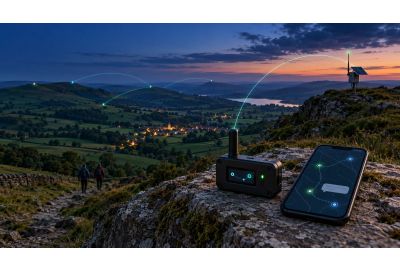
Imagine being halfway up a hillside with no mobile signal, able to send a text message to the rest of your group and see exactly where everyone is on a map. Or setting up a local wireless network for your street, estate or club without paying for infrastructure, contracts or servers. Or having a communication system that keeps working after a power cut or network failure, because it doesn't depend on any of those things.
That is what LoRa mesh networking makes possible. It is not a new idea, but it has reached a point where the hardware is compact and affordable, the software is mature and free, and the whole thing can be up and running from a standing start in the time it takes to charge a phone. ML&S stocks a growing range of LoRa and Meshtastic hardware, and this guide explains how the technology works, what the two main software platforms offer, and which devices are worth looking at.
What Is LoRa?
LoRa stands for Long Range. It refers to a wireless radio technology designed around a very specific set of priorities: small amounts of data, minimal power consumption, and an exceptionally robust radio link over surprisingly long distances. It is emphatically not designed for streaming, voice calls or large file transfers, and that deliberate narrowness is the source of its usefulness.
A text message, a GPS coordinate update, a temperature reading from a sensor: these contain very little data. You do not need megabits per second to send them, and LoRa does not try to provide that. Instead, it trades raw speed for range and battery life, using a modulation technique called Chirp Spread Spectrum (CSS) in which the transmitted signal sweeps continuously through a defined frequency range in a distinctive pattern. Because the receiver knows that exact pattern, it can detect and decode the signal even when it is extremely weak and buried in background noise, in much the same way that a rising whistle stands out from the general noise of a crowd.
How Far Does LoRa Really Reach?
This is the question everyone asks first, and the honest answer is that it depends heavily on conditions. There is no single "standard range." The same hardware can achieve very different results depending on where and how it is deployed.
A realistic picture of what to expect:
- Indoors or in dense urban areas with reinforced concrete, nearby buildings and interference: a few hundred metres to a couple of kilometres.
- Line of sight in open countryside, two devices carried on a hillside walk: typically 5 to 15 kilometres, sometimes considerably more with good conditions.
- A well-placed fixed outdoor antenna at an elevated point, covering a valley or town: 20 to 30 kilometres or more is achievable.
- In a mesh network, with intermediate nodes relaying messages: the effective range extends further with each additional node in the chain.
The most important lesson from these figures is that the hardware inside the device is only part of the equation. Antenna quality, installation height and the presence or absence of obstructions between the two points make at least as much difference as the radio module itself. A device placed on a windowsill will perform dramatically better than the same device on the floor in the corner of a room. A fixed node on a rooftop with an external antenna will extend network coverage in ways that no amount of extra transmitter power could match from ground level.
The UK Frequency Picture: 868 MHz and Licence-Free Operation
In the UK and across most of Europe, LoRa devices operate in the 868 MHz ISM band, which is allocated for licence-free short-range devices (SRDs). This means you do not need an amateur radio licence or any other authorisation to buy and use standard LoRa hardware running at 868 MHz, provided the device complies with the relevant technical limits.
Those limits include a maximum radiated power (which most off-the-shelf LoRa devices comply with by default) and a duty cycle restriction, typically 1% per hour on some sub-bands, which limits how much of the time a device can be actively transmitting. In practice, for messaging and position sharing this is not a constraint: a text message or GPS update takes a fraction of a second to transmit. The duty cycle only becomes relevant if a device is transmitting very frequently or continuously.
433 MHz and 868 MHz both have their characteristics. The lower frequency offers some physical propagation advantages in open conditions, while 868 MHz allows for significantly more compact devices: a quarter-wave antenna at 868 MHz is around 8.6cm, compared with around 17.3cm at 433 MHz. In practice, the availability of hardware, the prevalence of existing nodes and the legal operating conditions make 868 MHz the natural starting point for almost all UK LoRa projects.
From a Radio Link to a Mesh Network
Two LoRa devices can communicate directly if they are within range of each other. A mesh network extends this basic idea: if device A can reach device B and device B can reach device C, then A can send a message to C by routing it through B, even if A and C are outside each other's direct range. Each relay step is called a hop.
This means that a mesh network's effective coverage grows with every additional node that joins it. A hiker joining the group with a LoRa device automatically becomes a potential relay point for messages from others. A fixed node placed on a rooftop or hill extends the whole network's reach without any additional configuration. The network is self-organising by design.
Two software platforms currently dominate the LoRa mesh networking space: Meshtastic and MeshCore. Both run on compatible hardware and both use the 868 MHz LoRa radio link, but they approach network organisation differently.
Meshtastic: The Mobile, Flexible Network
Meshtastic is an open-source project that turns compatible LoRa hardware into a self-contained mesh communication network. Setup is straightforward: install the free Meshtastic app on a smartphone, connect it to a LoRa node via Bluetooth, and you are part of the network. No account, no server, no configuration beyond choosing a region and optionally setting up channels.
Meshtastic supports group channels (for open or encrypted group messaging), direct one-to-one messages between specific nodes, GPS position sharing and telemetry data. Nodes can be assigned different roles that influence how they behave in the network: a mobile node carried by a hiker participates differently from a fixed infrastructure node placed at an elevated point to extend coverage.
For groups who want to stay connected in areas without mobile signal, whether that is a hiking club, a family camping trip, an event organisation team or an emergency communications setup, Meshtastic is particularly well suited. The network is highly dynamic and self-organising, which makes it resilient and easy to expand simply by adding more devices.
Meshtastic also supports optional MQTT integration: nodes with access to a Wi-Fi network or the internet can bridge geographically separate Meshtastic networks together over the network, though this is entirely optional and not required for purely local, off-grid operation.
MeshCore: The Structured, Planned Network
MeshCore takes a more structured approach. Rather than a dynamic network where all nodes are broadly equivalent, MeshCore assigns three distinct roles to devices:
- Companion (end device): the personal LoRa device you carry and control via your smartphone over Bluetooth, USB or Wi-Fi.
- Repeater (relay station): a fixed node at an elevated location whose specific job is to extend network coverage by relaying messages. Unlike Meshtastic's more fluid role system, MeshCore repeaters are deliberately placed and configured as permanent infrastructure.
- Room Server (digital message store): an optional feature that acts as a local bulletin board or mailbox. Members can leave messages and retrieve them later, even if they were not online when the message was sent, without needing any external internet server.
This structured approach makes MeshCore particularly well suited to building reliable, planned coverage for a specific area, a neighbourhood, a club site, a farm or an event venue where you want predictable performance rather than an ad-hoc network. The trade-off is slightly less spontaneity: getting the most from MeshCore benefits from some planning about where repeaters should be placed.
Meshtastic or MeshCore: Which Is Right for You?
| Use case | Meshtastic | MeshCore |
|---|---|---|
| Text messaging without cellular signal | Very well suited | Very well suited |
| Getting started with a smartphone and one node | Particularly easy | Readily possible |
| Mobile or spontaneous networks (hiking, events, leisure) | Primary strength | Possible, different approach |
| GPS position sharing | Widely and intuitively integrated | Depends on client version |
| Planned fixed relays at elevated points | Possible (infrastructure roles) | Primary strength |
| Building planned regional coverage | Possible | Excellent core capability |
| Group channels for ongoing chat | Channels for group messaging | Channels plus optional Room Server |
| Offline message retrieval (mailbox/BBS) | Not a core feature | Specifically supported via Room Server |
| Optional internet bridging (MQTT) | Yes, via MQTT broker | Not central to the concept |
| Use on amateur radio frequencies | Yes (amateur mode disables encryption) | Limited (encrypted by default) |
LoRa and Meshtastic Hardware at ML&S
ML&S stocks a range of LoRa and Meshtastic hardware, from compact entry-level nodes right through to solar-powered outdoor repeaters. Here is a look at the main options currently available.
Entry-Level and Portable Nodes
ThinkNode M2 Meshtastic Node with 1.3" OLED Display (868 MHz)
A compact and affordable entry point to Meshtastic, pre-installed with firmware and ready to pair with the Meshtastic app via Bluetooth. ESP32-S3 processor, SX1262 LoRa chip and a 1,000mAh battery. A sensible first node for anyone wanting to try Meshtastic without a large initial investment.
View at ML&SThinkNode M5 Pro GPS Meshtastic Node with 1.54" E-Ink Display (868 MHz)
A step up from the M2, adding an integrated GPS module for position sharing and a larger E-Ink display that is readable in bright sunlight. Pre-installed with Meshtastic firmware, 1,200mAh battery, compact closed-shell design. Includes free shipping. Well suited to outdoor and hiking use where GPS tracking matters.
View at ML&SThinkNode M3 Tracker Card with GPS / Wi-Fi / BLE (868 MHz)
A credit-card-sized Meshtastic node with GPS, Wi-Fi and Bluetooth. A practical option for slipping into a bag or pocket as a lightweight tracker or additional mesh node, and for projects where the compact form factor matters more than a built-in display.
View at ML&SThinkNode M4 MagSafe Power Bank Meshtastic Node with GPS (868 MHz)
A clever combination of portable power bank and Meshtastic node. The nRF52840 processor and Semtech LR1110 LoRa chip provide the mesh networking capability, while the built-in battery doubles as a charger for other devices. Includes GPS, temperature and humidity sensors and a six-axis gyroscope. Useful for field events or outdoor activities where having a backup power source alongside the mesh node makes practical sense.
View at ML&SSeeed XIAO ESP32S3 Meshtastic LoRa Node
A compact, open platform based on the XIAO ESP32S3 and Wio-SX1262 LoRa module, pre-flashed with Meshtastic firmware. Supports 862 to 930 MHz LoRa, 2.4GHz Wi-Fi and Bluetooth 5.0. Suitable for embedding into custom projects, experimenting with LoRa at a low cost, or building a dedicated Meshtastic node or router as part of a larger installation.
View at ML&SSeeed SenseCAP Solar Node P1 Pro Meshtastic / MeshCore LoRa Repeater
A rugged, solar-powered outdoor LoRa node with integrated battery, GPS and weather-resistant enclosure. Available with either Meshtastic firmware or MeshCore Repeater firmware, making it suitable as a permanent outdoor Meshtastic node or a fixed MeshCore repeater for extending planned coverage. Ideal for elevated installations, remote sites, farms or anywhere that mains power is not available. ML&S has one of these running as a live demonstration node.
View at ML&SGetting Started: What You Actually Need
Getting onto a LoRa mesh network is straightforward. The minimum requirement is two compatible nodes and a smartphone with the appropriate app. Here is the basic sequence:
- Order two compatible LoRa nodes (for example, two ThinkNode M2 or M5 units).
- Install the free Meshtastic app (iOS or Android) on your smartphone.
- Charge the nodes and connect one to your phone via Bluetooth in the app.
- Set the region to EU_868 in the app settings.
- Give the second node to another person with the app on their phone.
- Place both nodes where there is a reasonable chance of a radio path between them and send a test message.
That is all that is required for a first working link. From there, additional nodes can be added to extend the network, fixed nodes can be placed at elevated points to increase range, and more advanced features such as GPS tracking, channels and telemetry can be configured as needed.
Antennas and Range: Where the Real Gains Are
Once a basic link is working, the fastest way to improve range is not to increase transmitter power but to improve the antenna and its installation. The stock antennas supplied with most LoRa nodes are adequate for initial testing, but a better antenna at an elevated position will extend range dramatically.
For fixed nodes intended to provide wide-area coverage, an external antenna mounted as high as possible with a clear view to the horizon will achieve far more than any amount of firmware tuning. Coaxial cable losses at 868 MHz are significant, so keeping the cable run as short as practical and using decent-quality low-loss coax matters. A node on a rooftop with 5 metres of quality coax to an external antenna will cover an area that would be entirely out of reach from a node sitting on a desk inside the building.
Practical Use Cases
- SOTA and POTA activations: a LoRa node alongside the HF radio gives a simple, lightweight way to share positions and messages with a support group or fellow activators without depending on mobile coverage.
- Group walks and outdoor activities: everyone carries a node and the whole group can see each other's GPS positions and send messages without needing mobile signal.
- Club and event communications: a few fixed nodes around a site plus mobile nodes for the team provides coordination capability that doesn't rely on mobile networks potentially under load at a busy event.
- Emergency preparedness: a local mesh network of fixed nodes at key points, combined with mobile nodes carried by volunteers, provides resilient local communications that continue to function during mobile network outages or power cuts.
- Home and garden monitoring: sensors measuring temperature, humidity or power generation can transmit readings to a LoRa node, which relays them to a hub without needing Wi-Fi or cellular coverage at the sensor location.
- Experimentation and learning: LoRa and Meshtastic are a genuinely interesting technical project in their own right, combining radio propagation, low-power electronics, network protocols and practical deployment in a way that maps closely onto skills many radio amateurs already have.
Browse the full Meshtastic and LoRa range at ML&S, including all nodes, trackers and solar infrastructure hardware.
View Meshtastic and LoRa at ML&SDisclaimer: This article is intended as a general introduction to LoRa mesh networking for radio amateurs and technology enthusiasts. Frequency allocations, permitted power levels, duty cycle restrictions and licence conditions are subject to change by regulatory authorities. Always verify the current requirements in your country before operating. Licensed radio amateurs should check current licence conditions before using LoRa on amateur frequency bands. Product availability and specifications are subject to change; please check the ML&S website for current stock status.
