



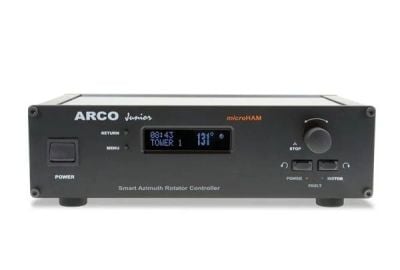
If your current rotator controller is a basic analogue box with a needle pointing roughly north and a switch you have to hold down while the beam slowly grinds toward the DX, the microHAM ARCO Junior is a significant upgrade in both capability and convenience. And if you are setting up a rotator for the first time and want something that will integrate cleanly with logging software, remote operation and your station network, it is arguably the controller to get right from the start.
microHAM are a Czech manufacturer with a long track record in high-quality shack interfaces and control hardware. Their approach with the ARCO Junior is the same as with their other products: build something genuinely universal, make the configuration menu-driven rather than hardware-dependent, and give it enough connectivity that it fits into any station setup, from a local shack to a fully remote internet-controlled installation.
Works With Almost Every Rotator
The headline claim is a bold one, but it holds up. The ARCO Junior is designed to be compatible with virtually every antenna rotator currently on the market, including popular models from Yaesu, Prosistel, DX Engineering, M2 and others. Rather than being hardwired for a specific rotator type at the factory, all rotor settings are configured through the menu, including compensation for cable losses in long rotator cable runs, which is a genuinely useful feature on installations where the control cable runs any significant distance.
The 90W motor driver (48VDC at 1.87A) built into this version covers the majority of rotators operators are likely to be running, including the full Yaesu range and the Prosistel 61D. For higher-powered units like the Prosistel 71D, DX Engineering RT4500 or M2 Orion, microHAM offer a 220W version (48VDC at 4.6A), which is available separately. Both versions use the same ARCO Junior controller logic and the same software environment.
Three Ways to Control It
The ARCO Junior gives you genuine flexibility in how you control it, covering everything from a traditional hands-on approach right through to full remote internet operation:
USB-B / RS-232
Direct connection to a shack PC. Works with logging software and rotator control applications via virtual COM port.
Ethernet Network
100-BaseTX network port for integration into your shack LAN or internet-connected remote station.
Front Panel Buttons
Manual operation via buttons and the LC direction display. No computer needed for basic day-to-day use.
The front panel LC display shows the current antenna heading at a glance, so you always know where the beam is pointing even when you are not looking at a screen. The manual buttons mean it works as a standalone controller if you want to keep things simple, and the USB and network interfaces open it up to full software integration when you need that capability.
The Built-in VNC Server: Control From Anywhere
One of the most useful features of the ARCO Junior is something that sets it apart from most rotator controllers at any price point: a built-in VNC server. VNC (Virtual Network Computing) is a standard protocol for remote desktop access, and the ARCO Junior uses it to replicate the exact ARCO display on any connected device: a PC, Mac, tablet or smartphone, using any standard VNC client or a web browser.
What this means in practice is that whether you are sitting at the operating position, working from another room, or connected remotely over the internet, you see exactly the same interface and have exactly the same control. There is no second-guess about what the controller is doing, because you are looking at its actual display rather than a separate application's interpretation of it. You can point the beam, check the heading, and access all the configuration menus, remotely, without opening the housing or running specialist software on the controlling device.
This makes the ARCO Junior a particularly good fit for remote stations. The rotator becomes just another part of the station you can manage from your laptop or phone, alongside the radio itself.
Menu-Driven Configuration: No Soldering, No Jumpers
A traditional rotator controller often requires physical adjustments inside the housing when you change rotators, including wiring changes, calibration trimmers and occasionally jumper settings. The ARCO Junior eliminates all of that. Every setting, including rotator type, travel limits, speed control, cable compensation and direction calibration, is configured through the front panel menu or via VNC, with no need to open the enclosure.
This is a meaningful practical advantage. If you upgrade your rotator, or add a second installation, you reconfigure through the menu rather than physically modifying the controller. And the self-explanatory error messages built into the firmware mean that if something goes wrong, the controller tells you what the problem is rather than leaving you to work it out from a flickering needle.
Compatible Rotator Guide
| Power Supply | Compatible rotators |
|---|---|
| 90W (48VDC / 1.87A) — this version | Yaesu (full range), Prosistel 61D, and most standard rotators |
| 220W (48VDC / 4.6A) — optional | Prosistel 71D, DX Engineering RT4500, M2 Orion, and other high-power rotators |
The ARCO Extension Accessories
Three extension modules are available for the ARCO Junior at ML&S, each adding a meaningful capability to the base system. They connect to the ARCO Jr and are controlled through the same interface, keeping everything in one place.
ARCO Extension: Wind Sensor
Adds wind speed monitoring to the ARCO system. When wind speeds exceed a configured threshold, the controller can automatically park the antenna in a safe position, protecting your beam and rotator from storm damage without any manual intervention.
View at ML&SARCO Extension: Magnet Compass
A magnetic compass module that provides an independent, absolute direction reference for the antenna. Useful for cross-checking the rotator's position feedback, for installations where the rotator's own position sensor is less precise, or where you want a second reference for calibration purposes.
View at ML&SARCO Extension: 4 Relays
Adds four independently switchable relays to the ARCO system, controllable through the same VNC interface or via software. Ideal for automating antenna switching, coax relay control, band-pass filter switching or any other relay-based task that benefits from being coordinated with antenna heading.
View at ML&SSpecifications
| Specification | Details |
|---|---|
| Brand | microHAM |
| Model | ARCO Junior |
| SKU | MHAM-ARCO-JUNIOR-90W |
| Max motor power | 90W (48VDC / 1.87A) |
| Controller power | External 13.5V DC (supplied separately) |
| Interfaces | USB-B, RS-232, Ethernet (100-BaseTX) |
| Remote control | Built-in VNC server (PC, tablet, smartphone, web browser) |
| Display | LC display for direction indication |
| Configuration | All settings menu-driven via VNC, no hardware changes required |
| Housing | Compact aluminium, 265 x 82 x 150mm (W x H x D) |
| Compatible rotators | Almost all types including Yaesu, Prosistel, M2, DXE |
| Expansion | Wind sensor, magnet compass, 4-relay module (all optional) |
| Firmware | Protective functions and self-explanatory error messages built-in |
Who Is the ARCO Junior For?
It is the right controller for any operator running a directional antenna who wants more than a basic analogue controller can offer. In particular it suits:
- Remote station operators who need to control the rotator over the internet exactly as they would locally, using the VNC interface from any device.
- Contest operators who want seamless integration between rotator control and logging software via USB or network, with precise heading feedback and automatic positioning.
- DXers who want to combine rotator control with automated antenna switching using the relay extension module, all in one coordinated system.
- Anyone upgrading from a basic rotator box who wants menu-driven configuration, proper error reporting and the option to expand the system over time without replacing the controller.
- Operators planning a future remote or internet-controlled station who want to make sure the rotator side of that setup is already covered when the time comes.
The microHAM ARCO Junior is in stock now at ML&S, including the wind sensor, compass and relay extension modules.
View the ARCO Junior at ML&SDisclaimer: This post is based on microHAM's published product information for the ARCO Junior, current at the time of writing. The ARCO Junior requires a separate 48V DC motor supply and a 13.5V DC logic supply, both sold separately. For rotators requiring more than 90W, a 220W version is available. Please check the product page at ML&S for current stock status and accessory availability.
