



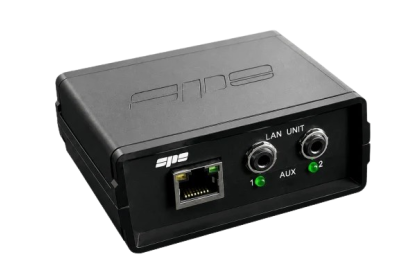
Remote operation has become an increasingly important part of amateur radio, whether that means controlling a station from another room, running a contest remotely, or managing a dedicated remote shack over a VPN. For operators running a compatible SPE amplifier, the new SPE LAN-UNIT is a compact network interface accessory that adds Ethernet, Wi-Fi and Bluetooth connectivity to the amplifier in one clean upgrade, with no need for a separate power supply or complicated installation.
The LAN-UNIT connects directly to the amplifier's PORT communication connector using a standard straight-through DB9 serial cable, draws its power from that same connection, and immediately opens up four different ways to control the amplifier over a network. It is now in stock at ML&S at £219.95.
What Does the SPE LAN-UNIT Actually Do?
In short, it sits between your amplifier and your network and gives the amplifier a presence on that network. Once connected and configured, the LAN-UNIT's assigned IP address is displayed on the amplifier's System Info screen. Point a modern web browser at that address from any device on the same network and you have full browser-based control of the amplifier's functions, without needing to be physically at the radio or connected via USB.
Beyond the web interface, the LAN-UNIT also supports a virtual COM port over TCP on port 7388, which means existing SPE Term_232 software and other compatible logging or control applications can communicate with the amplifier over the network exactly as if they were connected via a physical serial port. For operators who have already built workflows around serial-based amplifier control, that is a useful bridge rather than a complete change of approach.
Four Operating Modes
The LAN-UNIT supports four distinct operating modes depending on how it is connected and what you need to do:
| Mode | How it connects | How you control it |
|---|---|---|
| Ethernet | LAN cable plugged in at power-up | Web browser via the unit's local IP address |
| Wi-Fi | Stored Wi-Fi credentials, no LAN cable connected | Web browser via the unit's local IP address |
| Bluetooth | No LAN cable connected, Bluetooth mode active | SPE Term_232 or equivalent via virtual COM port |
| Virtual COM | Ethernet or Wi-Fi active | TCP socket on port 7388, mapped to a virtual COM port |
The unit automatically selects Ethernet mode if a LAN cable is detected at power-up. If no cable is present and Wi-Fi credentials have been stored, it connects to your Wi-Fi network instead. Bluetooth mode is available as an alternative wireless option, particularly useful for operators who prefer SPE Term_232 or similar serial-based software and want to cut the cable without moving to full network operation.
Web Interface Control
The web interface is built on HTML and JavaScript and runs directly in any modern browser, including Chrome, Firefox, Edge and Safari, on a PC, Mac, tablet or smartphone. There is no software to install on the controlling device beyond a working browser. For operators who want to customise their setup further, the LAN-UNIT also supports custom JavaScript user interface uploads, so the web console can be tailored to your own workflow if needed.
This makes the LAN-UNIT particularly well suited to contest station setups where the amplifier needs to be monitored and adjusted without leaving the operating position, or to shack arrangements where the amplifier is rack-mounted or physically awkward to access during a session.
Wi-Fi and Bluetooth Notes
For wireless use, the LAN-UNIT supports 2.4GHz Wi-Fi only, using IEEE 802.11 b/g/n compatible access points with WPA2-PSK security recommended. It is worth noting that 5GHz Wi-Fi is not supported, so if your router or access point broadcasts only on 5GHz you will need to ensure a 2.4GHz network is available in the shack.
In Bluetooth mode, the LAN-UNIT presents itself as an SPE Bluetooth serial device using the Bluetooth Serial Port Profile, compatible with SPE Term_232 and equivalent applications via a virtual COM port on the controlling device.
Auxiliary Outputs
A neat additional feature is the pair of remotely switchable auxiliary outputs that can be toggled from the web console. These use an open-collector low-side switching arrangement and are designed for tasks such as switching additional cooling fans, engaging receive bandpass filters, or similar external switching during a remote session. SPE recommends wiring these with suitable relay protection where required, and the open-collector arrangement means they should be treated as switch outputs rather than power outputs.
System Requirements
Before ordering, it is worth checking the following requirements against your existing SPE amplifier setup:
| Requirement | Details |
|---|---|
| Compatible amplifier | SPE amplifier equipped with PORT socket |
| Amplifier firmware | Newer than version 08_06_26_A |
| Amplifier connection | Standard straight-through DB9 serial cable to PORT connector |
| Ethernet network | 10/100/1000Mbps, with DHCP server for IP assignment |
| Browser | Chrome, Firefox, Edge, Safari or equivalent modern browser |
| Wi-Fi | 2.4GHz IEEE 802.11 b/g/n only (5GHz not supported) |
| Bluetooth | Device supporting Bluetooth Serial Port Profile |
| Bluetooth software | SPE Term_232 or equivalent |
Important Notes Before Buying
This listing covers the SPE LAN-UNIT network interface only. Amplifier, network cables, router, computer and other station accessories are not included. Please confirm that your SPE amplifier has the correct PORT socket and is running compatible firmware before ordering.
Full Specifications
| Specification | Details |
|---|---|
| Brand | SPE |
| Product type | Network interface for compatible SPE amplifiers |
| Connectivity | Ethernet, Wi-Fi (2.4GHz), Bluetooth |
| Ethernet speed | 10/100/1000Mbps network compatible |
| Wi-Fi standard | IEEE 802.11 b/g/n (2.4GHz only, 5GHz not supported) |
| Bluetooth | Bluetooth Serial Port Profile |
| Virtual COM port | TCP socket on port 7388 |
| Web interface | HTML/JavaScript browser interface, custom JS uploads supported |
| Power source | Powered from amplifier PORT connector, no external PSU required |
| Amplifier connection | PORT connector via straight-through DB9 serial cable |
| Auxiliary outputs | 2 x remotely switchable AUX outputs (open-collector low-side) |
| Recommended remote access | LAN, VPN, or SSH tunnel |
| SKU | SPE-LAN-UNIT |
Who Is the SPE LAN-UNIT For?
The LAN-UNIT is most obviously aimed at operators who already own a compatible SPE amplifier and want to move away from a direct USB connection to something more flexible. If you run a separate shack PC and want to control the amplifier from across the room without a trailing USB lead, the Ethernet or Wi-Fi web interface makes that straightforward. If you are building a remote station and want to include the amplifier in your remote control setup, the LAN-UNIT gives the amplifier a proper network presence that works well alongside VPN-based remote access to the transceiver itself. And if you run contesting software that uses SPE Term_232, the virtual COM port mode means you can keep using that workflow over the network without modification.
For fixed stations, contest stations and remote setups alike, it is a clean and well-thought-out upgrade for any shack already built around SPE amplifier hardware.
View the SPE LAN-UNIT at ML&S
Disclaimer: This post is based on SPE's published product information for the LAN-UNIT, current at the time of writing. Compatibility depends on your specific SPE amplifier model and firmware version. Please check the product page at ML&S and confirm compatibility with your amplifier before ordering.
