



What is it?
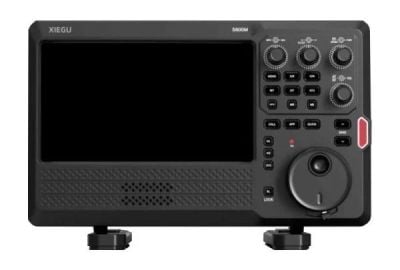
Xiegu announced the G7250 on 22 July 2026. Until now the brand has been best known for small, affordable portables — the G90 (20W), the X6100 and X6200 (QRP with built-in batteries and screens). The G7250 is a different animal: a 100W HF + 50 MHz transceiver built around a direct RF-sampling SDR receiver, in a two-box design: a standalone control head and a separate RF deck, linked by a cable.
The front end is a 7-inch capacitive touchscreen with a spectrum scope and waterfall, but Xiegu has kept physical buttons and rotary encoders alongside it, so you’re not stuck prodding glass for everything. Because the head is a standalone unit, you can put the RF deck under the desk or out of the way and keep just the screen and controls in front of you.
Headline specs
| Spec | G7250 (preliminary) |
|---|---|
| Coverage | 0.5–30 MHz, 50–54 MHz (160m–10m + 6m). No WFM / FM broadcast receive — some dealers list 78–108 MHz WFM, but there is no WFM mode on the unit we have |
| TX power | 100W ±1 dB on HF, 90W ±1 dB on 6m |
| Modes | SSB, CW, AM, NFM, DIG |
| Receiver | Direct RF-sampling SDR with multi-stage front-end filtering |
| Sensitivity | 0.2–0.25 µV SSB/CW/FM, 2 µV AM (sources vary) |
| MDS | −138 dBm |
| Display | 7-inch capacitive touchscreen in a standalone control head, spectrum + waterfall |
| ATU | Built-in, 20–150 Ω; first tune ≤10 s, memory recall ≤0.1 s |
| Antenna ports | 2 × SO-239, selectable |
| Tuning step | 1 Hz minimum |
| Power supply | 13.8V DC nominal (9–15V quoted); ~1.2A RX, up to 25A TX |
| RF deck size (measured) | 260 mm long × 210 mm wide × 90 mm high (table top to top of case) |
| Control head size (measured) | 250 mm wide × 150 mm high (plus up to 25 mm for the feet); 40 mm deep, 60 mm including the knobs |
| Weight | 5.8 kg quoted by dealers (not yet weighed — likely the boxed weight, as dealers’ 41 × 27 × 24 cm size is clearly the box) |
| Operating temp | 0–55 °C |
Features worth getting excited about
- One-cable digital modes. There’s a built-in USB sound card, so FT8/FT4 with WSJT-X should be a single USB lead for both audio and CAT — no interface box, no tangle of audio leads.
- Network baseband streaming. Xiegu mentions “remote baseband signal transmission over a network”. Xiegu have since confirmed this means LAN connection to a Windows PC running HDSDR — receive only for now (more below).
- Two antenna sockets + ATU with band memory — switch between, say, an end-fed and a 6m beam without swapping coax.
- SWR sweep built in, so you can get a rough idea of an antenna’s resonance without an analyser.
- Voice memory keyer and CW messages for contesting or calling CQ (voice recording needs a microSD card).
- Adjustable DSP filters, noise reduction and noise blanker.
Price and availability in the UK
| Dealer | Price | Status |
|---|---|---|
| ML&S Martin Lynch & Sons (UK) | £949 | Pre-order, delivery date TBC |
Prices correct at the time of writing (late September 2026). In the box you should get the control head, RF unit, link and data cables, hand mic, DC power lead and manual. A matching GY-10 external speaker is sold separately. If you order direct from outside the UK, remember import VAT and handling fees can eat the saving.
Where to buy in the UK: the G7250 is available to pre-order now from ML&S Martin Lynch & Sons at £949,
UK licence note
At 100W the G7250 sits comfortably within the Ofcom limits for Full and Intermediate licence holders. Foundation holders will need to wind the power down to stay legal — the rig’s power setting makes that easy, but it’s worth checking your current licence conditions before you key up.
How does it stack up?
The obvious comparison is the Icom IC-7300: same basic recipe (direct-sampling SDR, 100W, touchscreen, internal ATU, HF + 6m). The G7250 brings a bigger screen, a standalone control head, two antenna ports and network streaming. What Icom has is years of proven reliability, a mature firmware, and a huge ecosystem of accessories and software support. The Yaesu FT-710 is the other one to beat, particularly on receiver performance.
Against its own family, the G7250 is a big step up from the G90 — five times the power, a proper screen and a modern SDR front end — and it fills the gap for anyone who’s had an X6100 as a portable and wants something Xiegu-flavoured for the shack.
Hands-on: tested here
We’ve had a pre-production G7250 on the bench and on air here. It’s running pre-release firmware, so bear that in mind, but it gives a very good feel for where the radio is heading.
- Noise reduction. Exceptional at this price point. The NR pulls weak signals out of the band noise without turning the audio into that watery, robotic mush you get from a lot of cheaper DSP. This was the standout of our testing.
- Menus and touchscreen. The menu system is easy to find your way around, and the touch display is responsive and easy to use. You’re not digging through layers of sub-menus to change everyday settings.
- Tap and pounce — not there yet. The click-on-the-waterfall-to-tune feature you’d normally expect on an SDR like this still needs developing and adding. We’re on pre-release firmware, so this is one to watch for in updates rather than a deal-breaker, but it’s a feature a lot of SDR users will miss on day one.
- No FM broadcast (WFM). Some dealer listings mention WFM reception on 78–108 MHz. There is no WFM mode on the unit we have, so don’t buy it expecting an FM broadcast receiver.
- Power on FT8 — we recommend 25 W. FT8 and other digital modes are full-duty-cycle: the transmitter is at full output for the whole 13-second transmit period, over and over. That’s much harder on the PA and power supply than SSB voice, where average power is far below peak. Our rule of thumb, for the G7250 and for nearly any 100 W transceiver, is to run digital modes at about 25 W — roughly the radio’s AM carrier rating, which is the continuous power it’s designed to handle. FT8 is so efficient you’ll rarely notice the difference on air, and your radio will run cooler and last longer.
- No CW decoder (yet). One dealer lists built-in CW and digital-mode decoding, but we couldn’t find any CW decoding on the pre-release firmware we’re running. The radio does have preset CW message memories for sending. If a decoder matters to you, check whether a later firmware adds it before you buy.
- A few odd signals with nothing connected. With no antenna on the receiver, a few odd signals showed up on the waterfall. They disappear as soon as an antenna or a dummy load is connected, so they don’t affect real-world use — but don’t be alarmed if you see them while testing on the bench.
- Build quality — inside and out. We had the covers off. The build quality inside is exceptional for the price, and the layout lends itself to servicing and repair — better in that respect than some of the more established brands. Outside, the case, controls and standalone head feel solid and well put together, especially at around £950 in the UK.
Overall, the things that are hard to fix later — build quality, serviceability and receive audio — are already in very good shape. What’s missing, like tap and pounce, is software, and that’s the part that firmware updates can add.
Straight from the factory: network, 27 MHz and that touch beep
After our time with the radio we put a few questions to the Xiegu factory, and they came back with clear answers.
- Network / LAN. The G7250 has a LAN port and can be connected to a Windows PC and run from HDSDR for receiving. Xiegu will supply the DLL plugin HDSDR needs. With the current firmware, network control is receive only — you can’t transmit over the network yet. So for now think of it as a very handy networked SDR receiver (big waterfall on your PC screen, or listening from another room) rather than a full remote station. Whether transmit arrives in a later firmware is the big one to watch.
- 27 MHz and other non-amateur frequencies. There’s currently no modification or solution to open up 27 MHz or other frequencies outside the amateur bands. That matters mainly to commercial users, and to specialist groups such as the Scouts and other youth organisations that may hold government-allocated frequencies. For now, the G7250 is an amateur-band radio only, so those users will need to look elsewhere.
- Touchscreen beep. The beep you hear on every touch is normal feedback, not a fault. There’s currently no way to turn it off, but Xiegu say they’ll look at adding an option to disable it in a future firmware update.
What we don’t know yet
- Real receiver performance. Sensitivity and MDS figures are easy to hit. The numbers that matter on a busy band — blocking, reciprocal mixing, phase noise — need independent lab tests.
- Firmware maturity. Xiegu radios have historically launched a bit rough and improved through firmware updates. Early adopters should expect some of that.
- Rear panel detail — ACC socket, linear amp keying, external ATU support haven’t been fully published yet.
- Network transmit and remote. Receive over LAN with HDSDR is confirmed; whether transmit, remote CAT control and operating from outside the house will follow in firmware is still an open question.
Verdict (for now)
The G7250 is a very tempting package for the money: a 100W HF/6m SDR with a big 7-inch touchscreen head, dual antenna ports, ATU and single-cable FT8 for under £1,000 in the UK. From our testing of the pre-production unit, the noise reduction, easy menus and serviceable build already punch well above the price — features like tap and pounce just need firmware to catch up. Put simply, there’s nothing else offering this much radio for the money right now.
Our advice: don’t wait. A 100W HF/6m SDR with this build quality at £949 is going to be very popular, and first-batch stock won’t hang around. A deposit with ML&S secures your place in the first UK batch.
Pre-order your Xiegu G7250 from ML&S now »We’ll keep this post updated as new firmware arrives.
Disclaimer: All information is based on a pre-production unit running pre-release firmware. Specifications, features and pricing are subject to change by the manufacturer without notice. Please check the ML&S product page for the latest details.
