



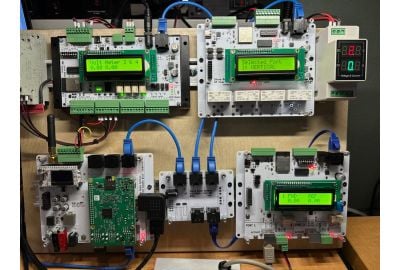
If you have ever wanted to walk into a shack and have everything come to life at the press of a single button, or manage a remote radio site without driving out to check on it in person, you already understand the problem that the Sierra Radio Systems Station Controller is designed to solve. It is a modular, expandable hardware and software platform that lets you monitor and control the critical systems in your station, whether that is a local shack, a remote HF station operated over the internet, a hilltop repeater, or any combination of the three.
ML&S now stocks the full Sierra Radio Systems range across twelve products, covering every module in the system from the core Raspberry Pi host adaptor through to wireless LoRa data radio modules and individual DIN rail relay accessories. Here is a thorough look at what the system is, how it works, and what each module does.
What Is a Station Controller?
In its simplest form, a station controller is a layer of hardware and software that sits between you and your equipment, giving you centralised visibility and control over things that would otherwise require you to be physically present. For a local shack, that might mean a single dashboard showing DC voltages, RF power levels and equipment status, with the ability to switch antennas or power accessories on and off from a single point. For a remote site, it might mean the difference between driving two hours to reset a stuck relay and doing it from a web browser at home.
Sierra Radio Systems has designed their controller specifically with amateur radio use cases in mind: remote HF stations, repeater and APRS sites, solar and battery monitoring, antenna switching, and general shack integration. The system is built around open standards and a published communications protocol, so it is not a closed ecosystem. You can use the supplied Node-Red dashboard, write your own Python or other scripts, or extend the system in any direction your needs take you.
Hardware Architecture: The Modular Approach
The defining characteristic of the Sierra Radio Systems design is its modularity. Rather than a single box that does everything, the system is built from individual modules, each performing a specific function, all communicating over the same network. You start with what you need and add modules as your station grows or your requirements change.
All modules share the same physical form factor and mounting system. They can be installed in a chassis box, a rack-mount enclosure, or mounted directly to DIN rails using standard industrial DIN rail hardware. The DIN rail approach is familiar from telecom and industrial automation environments and makes for a very neat, expandable installation that can be reconfigured without special tools.
The Device Control Network (DCN)
At the heart of the system is the DCN, or Device Control Network. This is the communications bus that connects all modules together, carrying both power and data over a single CAT5 or better cable using RS-485 multi-drop serial wiring. The practical implications of this are significant:
- You only need to run one cable between modules. Power and data travel together.
- RS-485 can reliably carry data over several hundred metres, and potentially thousands of feet, making it possible to locate modules physically away from the host computer without any additional infrastructure.
- Adding a new module is as simple as plugging in a CAT5 cable. Every module has its own address on the network, so multiple modules of the same type can coexist without conflict.
- The protocol is published and uses simple ASCII text, so advanced users can monitor and inject traffic using a standard terminal program and a USB to DCN dongle.
For sites where running a cable is not practical, the system also supports wireless DCN extension via LoRa radio modules operating in the 868MHz ISM band (the European allocation), allowing modules to communicate over the air between physically separate locations.
Software: Node-Red and Open Protocol
The master controller runs on a Raspberry Pi executing Raspberry Pi OS. Sierra Radio Systems provide a Node-Red flow that serves as the main dashboard and control panel, accessible from any web browser on the local network or remotely over a VPN or internet connection. Node-Red is a visual, flow-based programming environment that makes it straightforward to build control logic, scheduled events and custom dashboards without deep programming knowledge.
For operators who want to go further, the DCN protocol is fully published and sample applications are provided in both Node-Red and Python. You can build integrations with logging software, SDR platforms, or any other system that can run code. Sierra Radio Systems explicitly supports the idea of users designing their own modules and applications on top of the platform.
The Modules Available at ML&S
Core Infrastructure
SIR-310 Raspberry Pi Host Adapter with RPi 3
The foundation of every Sierra Radio Systems installation. The SIR-310 provides the interface between the Raspberry Pi host computer and the DCN, plus the power management and distribution needed for the controller. Supplied with a Raspberry Pi 3, pre-configured and ready to run the Node-Red dashboard. The natural starting point for any new system.
View at ML&SSIR-300 Station Controller Installation Kit
The mechanical installation kit for the Sierra Station Controller, containing the mounting hardware, DIN rail components and cabling accessories needed to assemble a neat installation. An essential add-on for anyone building a permanent installation in a chassis or on a telco wall.
View at ML&SSIR-356 DCN Data and Power Hub
A 5-port DCN hub that expands the network and power distribution within the system. Required when you need to connect more modules than a simple daisy-chain arrangement allows. The hub also handles power distribution across the DCN, simplifying the wiring of larger installations.
View at ML&SSIR-462 DCN LoRa Data Radio
Adds wireless DCN capability using a Heltec LoRa Meshtastic V3 module operating in the 868MHz ISM band. Allows Sierra Radio Systems modules to communicate over the air between locations where running a cable is not practical, such as between a shack building and a remote antenna or equipment enclosure.
View at ML&SControl and Monitoring Modules
SIR-321 General Purpose GPIO Module
The most versatile module in the range, providing four small-signal SPST relays, four open-collector outputs for controlling external high-current relays, four 0 to 50V DC volt meters, four opto-isolated digital inputs, and two digital temperature probe inputs. Covers the majority of monitoring and switching requirements for a typical station or remote site.
View at ML&SSIR-335 Two Port RF Watt Meter Control Module
Integrates with WaveNode directional couplers to provide two-channel RF power monitoring across the DCN. Supports the WaveNode HF-1 (0 to 2000W HF), LP-1 (0 to 60W HF) and UHF-1 (0 to 300W VHF/UHF) couplers. Includes PTT input and PTT output for transmitter keying and status monitoring.
View at ML&SSIR-361 Universal Antenna Relay Control Module
A general-purpose relay control module for driving external antenna relays, switching systems and similar accessories. Provides the control outputs needed to operate virtually any relay-based antenna switching system from the DCN, controlled from the Node-Red dashboard or via the published protocol.
View at ML&SCoax Switch Modules
SIR-331 Four Port HF and 6m Coax Relay Module
A four-position coax switch module covering 0 to 60MHz with BNC connectors. Up to 100W power handling, less than 0.05dB insertion loss, and latching relays that hold their position without continuous power. Controlled over the DCN or via manual pushbuttons on the module. An optional LCD display can be added for local status indication.
View at ML&SSIR-332 Two Port VHF and UHF Coax Relay Module
A two-port coax relay module optimised for VHF and UHF frequencies, providing network-controlled coax switching for the higher bands. DCN controlled and compatible with the same software environment as the rest of the system, allowing HF and VHF/UHF antenna switching to be managed from the same dashboard.
View at ML&SRelay and Sensor Accessories
SIR-452 Digital Temperature Sensors (Pack of 2)
A pair of digital temperature probe sensors for use with the GPIO module's temperature probe inputs. Useful for monitoring equipment temperatures in enclosed chassis or remote enclosures, or for environmental monitoring at an unmanned site.
View at ML&SSIR-471 20A DC Power Relay Partial Kit with Powerpole Connectors
A 20A DC power relay kit with Powerpole connectors for switching higher-current DC loads under GPIO control. The open-collector outputs on the GPIO module are designed to drive relay coils, and this kit provides the external relay element needed to switch loads like transceivers, amplifiers or power supplies.
View at ML&SSIR-472 Slim DIN Rail 6A Relay
A slim DIN rail-mounted 6A relay for use in the same enclosure or DIN rail installation as the Sierra Radio Systems modules. Provides a compact and tidy way to add switching capacity for lower-current loads alongside the main control modules.
View at ML&SFull Range at a Glance
| SKU | Product | Function |
|---|---|---|
| SIR-310 | Raspberry Pi Host Adapter with RPi 3 | System host, DCN interface, core of every installation |
| SIR-300 | Station Controller Installation Kit | DIN rail mounting hardware and installation accessories |
| SIR-321 | General Purpose GPIO Module | Relays, volt meters, digital inputs, temperature probes |
| SIR-331 | Four Port HF and 6m Coax Relay Module | Network-controlled coax switching, 0 to 60MHz |
| SIR-332 | Two Port VHF and UHF Coax Relay Module | Network-controlled coax switching, VHF and UHF |
| SIR-335 | Two Port RF Watt Meter Control Module | Two-channel RF power monitoring via WaveNode couplers |
| SIR-356 | DCN Data and Power Hub | 5-port DCN network and power expansion hub |
| SIR-361 | Universal Antenna Relay Control Module | External relay driving for antenna switching systems |
| SIR-452 | Digital Temperature Sensors (Pack of 2) | Environmental and equipment temperature monitoring |
| SIR-462 | DCN LoRa Data Radio | Wireless DCN extension via 868MHz LoRa |
| SIR-471 | 20A DC Power Relay Kit with Powerpole | External high-current DC load switching |
| SIR-472 | Slim DIN Rail 6A Relay | DIN rail-mountable relay for lower-current switching |
Two Typical Use Cases
The integrated home shack
In a typical home shack setup, the SIR-310 host adapter provides the control hub, connected via DCN to a SIR-321 GPIO module monitoring DC supply voltages, equipment temperatures and a door/window sensor. A SIR-331 four-port coax switch module handles antenna selection. A SIR-335 RF watt meter module monitors forward and reflected power from a WaveNode coupler in the feedline. From a single Node-Red dashboard on a tablet or desktop screen, you can see the state of your entire station, switch antennas, monitor power and turn accessories on and off, all without leaving the operating chair.
The remote or repeater site
At an unmanned repeater or remote HF site, the same hardware takes on a different role. The GPIO module monitors the power supply voltage, battery state if solar-powered, transmitter PA temperature and any door or environmental sensors. The coax switch module allows the feedline configuration to be changed remotely. If the site loses mains power, the voltage measurements tell you before you make the trip. If the PA temperature is trending upward, you get an early warning. When something does need a physical reset, the relay outputs let you cycle power to equipment remotely. The SIR-462 LoRa radio module means none of this requires an internet connection at the remote site; the DCN data can be carried wirelessly between a gateway location and the site itself.
View Sierra Radio Systems at ML&S
Disclaimer: This post is based on Sierra Radio Systems' published product information and the packtenna.com website, current at the time of writing. Specifications and availability are subject to change. Please check the individual product pages at ML&S for current stock status. The SIR-335 RF Watt Meter module requires compatible WaveNode directional couplers, which are sold separately.
